Yummy Yummy
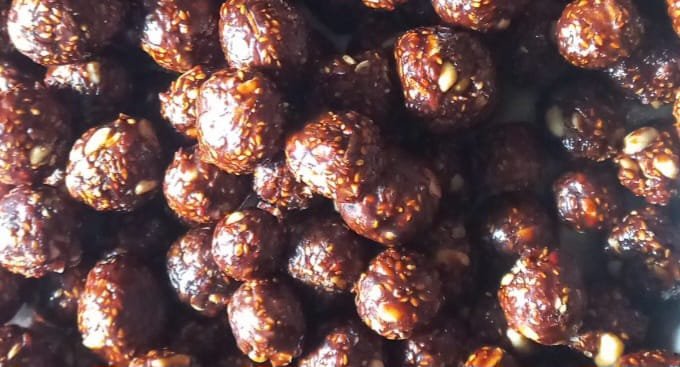
Tilaura- The Festival Sweet of Nepal.
Tilaura is a traditional sweet made in homes throughout Nepal, especially during winter festivals like Maghe Sankranti. These sesame seed laddus are also specially offered to Lord Ganesha, who is customarily worshipped before any other god or goddess in Hindu rituals.
The variations of Tilaura often reflect local tastes and family traditions. While a classic version uses only sesame seeds(तिल) and jaggery(सक्खर/भेली/गुड), many prefer to add ingredients like peanuts (बदाम), shredded coconut(नरिवल), or even spices like cardamom(सुकमेल) and Clove(ल्वाड़).
What You’ll Need: Ingredients
- Sesame seeds (Til) – the main ingredient
- Jaggery (Gur) – for natural sweetness and binding
- Peanuts – often roasted and added for crunch (optional)
- Coconut – grated or shredded, for flavor and texture (optional)
- Cardamom & Clove–powdered (to add spices for warm aroma)
- Ghee – clarified butter, for richness and binding
Making process:
Step 1 – Melting the Jaggery
Heat a pan on medium flame and add a small amount of ghee. Once melted, add jaggery and stir continuously until it is completely dissolved and forms a smooth, bubbling syrup.
Points to Remember:
- Crush the jaggery before adding it to the pan – this helps it melt evenly and prevents lumps.
- Use low to medium heat when melting jaggery to avoid burning.
- stir continuously once the jaggery is added to ensure a smooth syrup.
.
Points to Remember:
- Maintain low to medium heat until the jaggery is completely dissolved.
- to prevent burning- Stir continuously ·
- The mixture is ready when the jaggery completely dissolves and forms a sticky, thick syrup that holds its shape when tested in water (soft-ball stage).
- Work quickly once the syrup is ready, as it hardens as it cools. .
.
Step 2 – Mixing Ingredients
- Once the jaggery syrup is ready, quickly add all your chosen ingredients to the pan.
- For this recipe, I’ve added shredded coconut, crushed peanuts, and powdered cardamom and clove.
- Mix everything thoroughly while the syrup is still hot so that each ingredient is evenly coated and binds well.
Points to Remember:
- Mix everything thoroughly while the syrup is still hot so that each ingredient is evenly coated and binds well.
.
Step 3 – Shaping into Laddus
- Take a small portion of the warm mixture and roll it gently between your hands to form a round ball (laddu).
- Lightly grease your palms with a little ghee to prevent sticking.
- Work quickly while the mixture is still warm, as it hardens once it cools.
- It’s helpful to have someone assist you so the shaping can be done efficiently before the mixture cools.
Points to Remember:
Important Tip:
Remember to apply ghee on your hands before shaping the laddus. This not only prevents sticking but also protects your palms from burns, as you need to work quickly while the mixture is still very hot.
.
Step 4 – Cooling & Storage
- Let the laddus cool completely at room temperature.
- Place them in an airtight container or a sealed polythene bag.
- Store in a cool/dry place (no direct sunlight.)
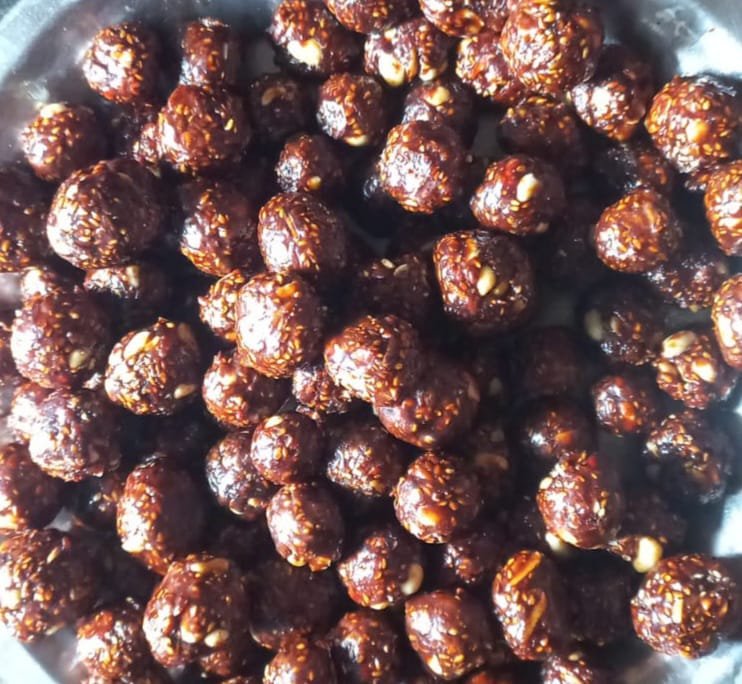
- Properly stored, Tilaura can stay fresh for up to 2–3 weeks.
“Now, your Tilaura is ready to eat and share.”
Where can we use these laddus(tilaura)?
As a Gift
It is often exchanged during festivals, special occasions, and family gatherings.
As Prasad / Religious Offering
It is offered to deities, especially Lord Ganesha, during prayers. After the ritual, it is distributed as prasad (a blessed offering shared among devotees).
During Festivals
Tilaura is a staple during winter festivals such as Maghe Sankranti, Tihar, and Dashain. It is also enjoyed during other festivals across South Asia.
As a Daily Sweet or Snack
It can be enjoyed with tea as a quick energy booster.
As a Chocolate Alternative
It can be enjoyed as a homemade, natural sweet, especially for children.
At Weddings, Birthdays, or Get-togethers
Tilaura is often included in the menu, representing hospitality and tradition.
When and how did I learn this recipe?
A special thanks to my Chandri didi for teaching me this wonderful recipe on the occasion of Maghe Sankranti.“I will always cherish the memory of learning this recipe from you. It brings me great joy to now share it with all of you, and I hope you enjoy making Tilaura as much as I do.”
Thank You!!!